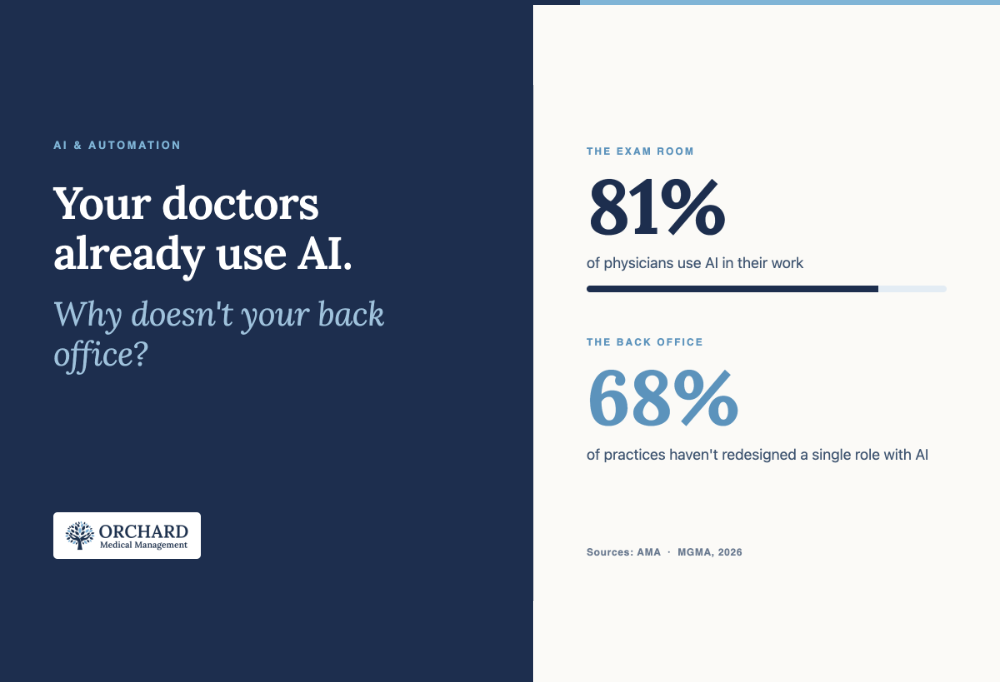
AI moved into the exam room fast. The work that keeps a practice paid hasn’t changed much at all.
Walk through an independent practice today and the contrast is easy to see. In the exam room, an ambient scribe drafts the visit note while the physician talks with the patient. Down the hall, the front desk is on hold with a payer, checking eligibility one patient at a time.
The research shows the same split. According to the American Medical Association, 81% of physicians now use AI in their professional work, more than double the 38% who said so three years ago. But in a June 2026 MGMA poll, 68% of practice leaders said their organization had not redesigned a single role or adjusted staffing with the help of AI in the past year.
Clinicians have adopted AI. Operations mostly haven’t.
Where the productivity gains are showing up
Fewer than half of practice leaders (46%) told MGMA that AI has made their providers more productive. Among the practices that did report gains, ambient AI scribes were the main driver.
That makes sense. Scribes are easy to adopt. They plug into one workflow, one person uses them, and the benefit shows up the same day. Back-office automation is harder because the work spreads across scheduling, eligibility, authorizations, claims, and posting, and it runs through several systems that were never designed to talk to each other.
Where back-office automation pays off first
When MGMA asked practice leaders where they plan to invest in AI, the answers pointed straight at the front office: scheduling (31%), phone calls (27%), registration and eligibility (23%), and prior authorization (16%).
Prior authorization is the clearest case. MGMA found that 92% of medical groups had hired or reassigned staff solely to keep up with prior authorization volume. Those are people whose whole job is checking portals, faxing documentation, and following up. That is exactly the kind of high-volume, rules-based work automation handles well, and it frees those staff for work that needs judgment.
Why so many AI tools disappoint
The usual pattern is buying a tool first and figuring out the process later. A practice signs up for an AI product, plugs it into a workflow nobody has mapped, and then wonders why the results don’t match the demo.
Automation doesn’t fix a broken process. It makes the process run faster, including the broken parts. The order that works is to map the workflow, decide what good looks like, measure the starting point, and only then automate the steps that are repetitive enough to hand off.
Governance is the other gap. Only 20% of medical group leaders told MGMA their organization has an AI governance structure or formal AI policy, and another 22% are working on one. The majority, 56%, have neither. Without one, nobody owns the questions that matter: which tools are approved, where patient data goes, and who checks the output.
Why this matters now
Margins are tightening. MGMA reports that 84% of medical groups saw higher operating costs than at the same point in 2025, and 36% of leaders named automation as their most important cost-cutting lever for the year.
For years, the default answer to more volume was more staff: another biller, another authorization specialist, another person on the phones. That model is getting harder to afford and harder to hire for. Automation offers another option: getting more out of the people and systems a practice already has.
Where to start
Pick one queue. Eligibility checks, prior authorizations, or claim status follow-up. Start where the volume is highest and the rules are clearest.
Measure the starting point. Staff hours per week, turnaround time, and error or denial rate. You need a before number to prove the after.
Map the workflow first. Write down every step and every system it touches before choosing any tool.
Automate inside your current systems. The best results usually come from working within the EMR, PM system, and clearinghouse you already use.
Set basic governance. Decide who approves tools, where patient data can go, and who reviews the output.
How Orchard approaches it
Orchard’s RCM Engineering works inside the EMR, practice management system, and clearinghouse a practice already owns. We don’t ask you to replace your systems or adopt a new platform. We map the workflow, find the manual steps that eat the most staff time, and automate them where the practice already does its work.
The physicians in your practice have already seen what AI can take off their plate. Your back office can get the same benefit.
Let’s engineer your revenue cycle
See where Orchard can manage, automate, and engineer more performance from the systems you already own.
orchardmedicalmgt.com | (603) 232-4513
Sources: American Medical Association, physician AI use survey; MGMA Stat polls, 2026, on AI adoption, staffing redesign, productivity, investment priorities, AI governance, and operating costs; MGMA research on prior authorization staffing.